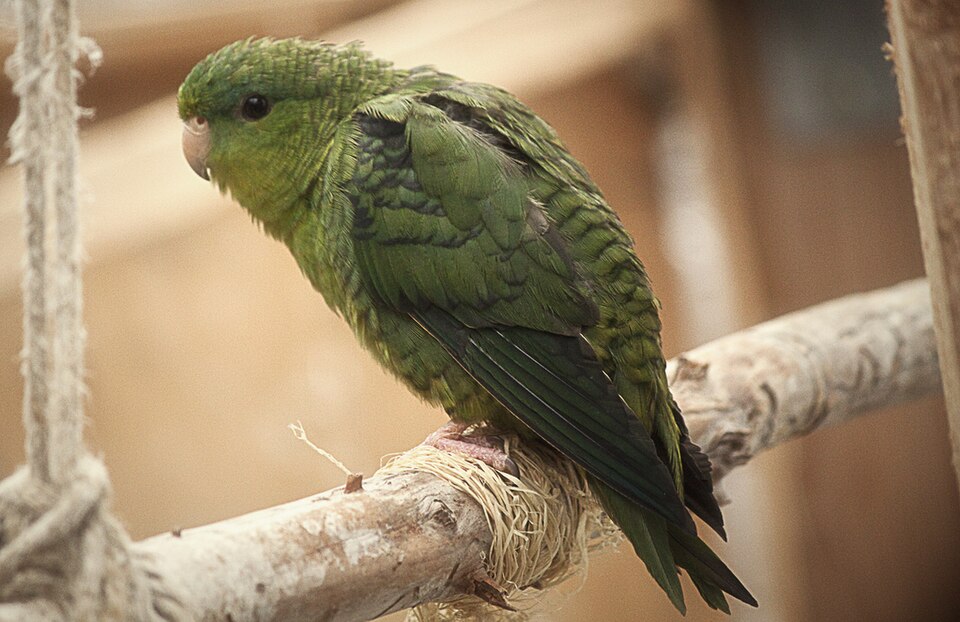
Lineolated Parrot Genetics & Mutations
Bolbohynchus lineola
Lineolated Parrot (Bolbohynchus lineola) inherit plumage coloration through the avian $ZZ/ZW$ chromosomal system. Cocks are homogametic ($ZZ$) and can carry hidden "split" alleles for sex-linked mutations. Hens are heterogametic ($ZW$) and possess only one $Z$ chromosome; consequently, female birds express sex-linked traits visually and can never be split carriers .
Taxonomic & Cytogenetic Profile
| Common Name | Lineolated Parrot |
|---|---|
| Scientific Binomial | Bolbohynchus lineola |
| Sex Chromosomes | Cock: $ZZ$ (Homogametic) • Hen: $ZW$ (Heterogametic) |
| Catalogued Mutations | 7 Documented Loci & Mutations |
| Calculation Engine Status | Mutations Catalogued • Rules Literature Review |
Featured Mutations in Lineolated Parrot
View all 7 mutations →Dark
DIncomplete dominant structural modifier compacting the spongy medullary barbule layer. 0 factors = light green/sky blue; 1 factor = dark green/cobalt; 2 factors = olive/mauve.
Bl
blAutosomal recessive inhibition of yellow/red psittacofulvin pigment synthesis (MuPKS locus in Melopsittacus undulatus). Light scattering across the spongy medullary layer appears blue without yellow ground color.
Turquoise(Parblue)
bltqAutosomal recessive inhibition of yellow/red psittacofulvin pigment synthesis (MuPKS locus in Melopsittacus undulatus). Light scattering across the spongy medullary layer appears blue without yellow ground color.
Ino
inoSex-linked recessive (Z-chromosome) complete inhibition of tyrosinase oxidation in melanocytes. Eliminates all black and charcoal eumelanin granules. Retains psittacofulvins, producing Lutino (yellow) or Albino (white) with ruby-red eyes.
Autosomal recessive reduction of eumelanin granule concentration across body plumage by approximately 50-80%, yielding a soft pastel wash.
Frequently Asked Questions About Lineolated Parrot Genetics
Direct scientific answers covering sex linkage, inheritance mechanics, and breeding odds.
What is the sex chromosome system in Lineolated Parrot?
Lineolated Parrot (Bolbohynchus lineola) utilize the avian ZZ/ZW chromosomal sex determination system. Males are homogametic (ZZ) and inherit two Z chromosomes, while females are heterogametic (ZW) and inherit a single Z chromosome and a maternal W chromosome.
Can female Lineolated Parrot carry split mutations for sex-linked traits?
No. In avian cytogenetics, female birds (hens) possess only one Z chromosome (ZW). Because the W chromosome carries no active pigmentation loci, any Z-linked mutation (such as Ino, Cinnamon, or Opaline) is expressed visually. Hens can never be heterozygous split carriers for sex-linked genes.
How do autosomal recessive mutations pass to offspring in Lineolated Parrot?
Autosomal recessive mutations (such as Blue or Fallow) require two copies of the mutant allele (homozygous) for visual expression. An offspring inheriting only one mutant allele from either parent will be visually wild-type but genetically split (a carrier).
Primary Literature & Taxonomic References
-
Martin, T. (2002). A Guide to Colour Mutations and Genetics in Parrots. ABK Publications, Tweed Heads, Australia. ISBN: 978-0957702479.
Relevance: International standard for parrot mutation nomenclature, Z-chromosome inheritance, crossing over, and linkage maps across Psittaciformes.
Access Source Reference → -
Taylor, T. G., & Warner, C. (1986). Genetics for Budgerigar Breeders (3rd ed.). The Budgerigar Society, UK.
Relevance: Foundational empirical breeding data documenting linkage and recombination frequencies on the Z chromosome for cinn-ino (3%), ino-op (33%), and cinn-op (30%).
Access Source Reference →