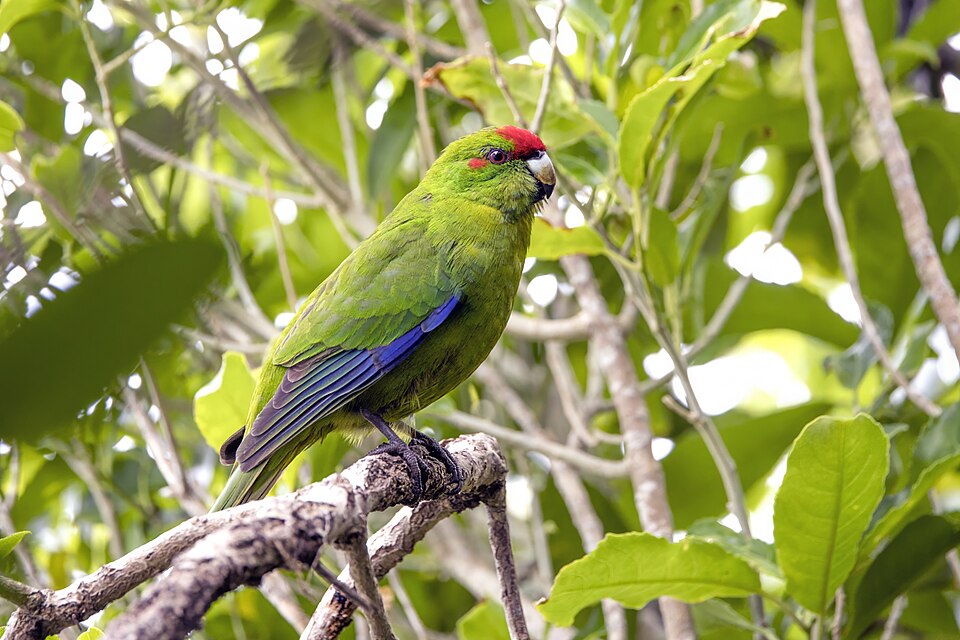
Red-fronted Kakariki Genetics & Mutations
Cyanoramphus novaezelandiae
Red-fronted Kakariki (Cyanoramphus novaezelandiae) inherit plumage coloration through the avian $ZZ/ZW$ chromosomal system. Cocks are homogametic ($ZZ$) and can carry hidden "split" alleles for sex-linked mutations. Hens are heterogametic ($ZW$) and possess only one $Z$ chromosome; consequently, female birds express sex-linked traits visually and can never be split carriers .
Taxonomic & Cytogenetic Profile
| Common Name | Red-fronted Kakariki |
|---|---|
| Scientific Binomial | Cyanoramphus novaezelandiae |
| Sex Chromosomes | Cock: $ZZ$ (Homogametic) • Hen: $ZW$ (Heterogametic) |
| Catalogued Mutations | 8 Documented Loci & Mutations |
| Calculation Engine Status | Mutations Catalogued • Rules Literature Review |
Featured Mutations in Red-fronted Kakariki
View all 8 mutations →Cinnamon
cinSex-linked recessive (Z-chromosome) arrest of eumelanin precursor oxidation at the brown intermediary stage. Plumage eumelanin is warm cinnamon-brown with plum-colored eyes at hatching.
Ino
inoSex-linked recessive (Z-chromosome) complete inhibition of tyrosinase oxidation in melanocytes. Eliminates all black and charcoal eumelanin granules. Retains psittacofulvins, producing Lutino (yellow) or Albino (white) with ruby-red eyes.
Dom Pied
PbAutosomal dominant failure of melanoblast migration from the neural crest during embryonic development, creating asymmetrical clear yellow or white plumage patches.
Rec Pied
sAutosomal recessive melanocyte migration arrest resulting in extensive symmetrical patches of unpigmented feathers and dark eyes.
Frequently Asked Questions About Red-fronted Kakariki Genetics
Direct scientific answers covering sex linkage, inheritance mechanics, and breeding odds.
What is the sex chromosome system in Red-fronted Kakariki?
Red-fronted Kakariki (Cyanoramphus novaezelandiae) utilize the avian ZZ/ZW chromosomal sex determination system. Males are homogametic (ZZ) and inherit two Z chromosomes, while females are heterogametic (ZW) and inherit a single Z chromosome and a maternal W chromosome.
Can female Red-fronted Kakariki carry split mutations for sex-linked traits?
No. In avian cytogenetics, female birds (hens) possess only one Z chromosome (ZW). Because the W chromosome carries no active pigmentation loci, any Z-linked mutation (such as Ino, Cinnamon, or Opaline) is expressed visually. Hens can never be heterozygous split carriers for sex-linked genes.
How do autosomal recessive mutations pass to offspring in Red-fronted Kakariki?
Autosomal recessive mutations (such as Blue or Fallow) require two copies of the mutant allele (homozygous) for visual expression. An offspring inheriting only one mutant allele from either parent will be visually wild-type but genetically split (a carrier).
Primary Literature & Taxonomic References
-
Martin, T. (2002). A Guide to Colour Mutations and Genetics in Parrots. ABK Publications, Tweed Heads, Australia. ISBN: 978-0957702479.
Relevance: International standard for parrot mutation nomenclature, Z-chromosome inheritance, crossing over, and linkage maps across Psittaciformes.
Access Source Reference → -
Taylor, T. G., & Warner, C. (1986). Genetics for Budgerigar Breeders (3rd ed.). The Budgerigar Society, UK.
Relevance: Foundational empirical breeding data documenting linkage and recombination frequencies on the Z chromosome for cinn-ino (3%), ino-op (33%), and cinn-op (30%).
Access Source Reference →