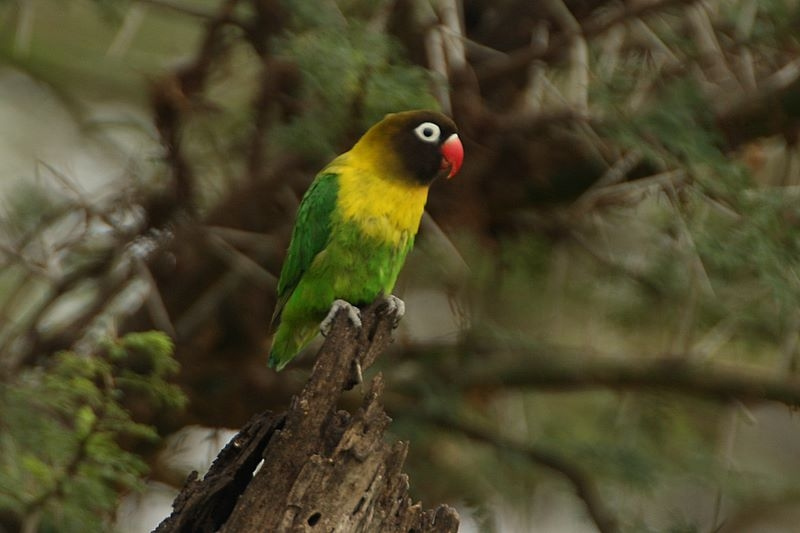
White eye-ring group Lovebirds Genetics & Mutations
Taxon under review
White eye-ring group Lovebirds (Taxon under review) inherit plumage coloration through the avian $ZZ/ZW$ chromosomal system. Cocks are homogametic ($ZZ$) and can carry hidden "split" alleles for sex-linked mutations. Hens are heterogametic ($ZW$) and possess only one $Z$ chromosome; consequently, female birds express sex-linked traits visually and can never be split carriers .
Taxonomic & Cytogenetic Profile
| Common Name | White eye-ring group Lovebirds |
|---|---|
| Scientific Binomial | Taxon under review |
| Sex Chromosomes | Cock: $ZZ$ (Homogametic) • Hen: $ZW$ (Heterogametic) |
| Catalogued Mutations | 17 Documented Loci & Mutations |
| Calculation Engine Status | Mutations Catalogued • Rules Literature Review |
Featured Mutations in White eye-ring group Lovebirds
View all 17 mutations →Violet
VIncomplete dominant structural modifier altering barbule micro-architecture to shift blue wavelength optical interference toward rich violet-purple hues.
Dark
DIncomplete dominant structural modifier compacting the spongy medullary barbule layer. 0 factors = light green/sky blue; 1 factor = dark green/cobalt; 2 factors = olive/mauve.
Blue
blAutosomal recessive inhibition of yellow/red psittacofulvin pigment synthesis (MuPKS locus in Melopsittacus undulatus). Light scattering across the spongy medullary layer appears blue without yellow ground color.
Turquoise(Parblue)
bltqAutosomal recessive inhibition of yellow/red psittacofulvin pigment synthesis (MuPKS locus in Melopsittacus undulatus). Light scattering across the spongy medullary layer appears blue without yellow ground color.
Frequently Asked Questions About White eye-ring group Lovebirds Genetics
Direct scientific answers covering sex linkage, inheritance mechanics, and breeding odds.
What is the sex chromosome system in White eye-ring group Lovebirds?
White eye-ring group Lovebirds (Taxon under review) utilize the avian ZZ/ZW chromosomal sex determination system. Males are homogametic (ZZ) and inherit two Z chromosomes, while females are heterogametic (ZW) and inherit a single Z chromosome and a maternal W chromosome.
Can female White eye-ring group Lovebirds carry split mutations for sex-linked traits?
No. In avian cytogenetics, female birds (hens) possess only one Z chromosome (ZW). Because the W chromosome carries no active pigmentation loci, any Z-linked mutation (such as Ino, Cinnamon, or Opaline) is expressed visually. Hens can never be heterozygous split carriers for sex-linked genes.
How do autosomal recessive mutations pass to offspring in White eye-ring group Lovebirds?
Autosomal recessive mutations (such as Blue or Fallow) require two copies of the mutant allele (homozygous) for visual expression. An offspring inheriting only one mutant allele from either parent will be visually wild-type but genetically split (a carrier).
Primary Literature & Taxonomic References
-
Van den Abeele, D. (2016). Lovebirds Compendium: Genetics and Colour Morphs of the Genus Agapornis. Ornitho-Genetics VZW, Belgium.
Relevance: Definitive genetic monograph on Agapornis species, defining autosomal recessive (blue, aqua, turquoise), incomplete dominant (dark), and sex-linked Z-chromosome loci (ino, cinnamon, opaline).
Access Source Reference → -
Martin, T. (2002). A Guide to Colour Mutations and Genetics in Parrots. ABK Publications, Tweed Heads, Australia. ISBN: 978-0957702479.
Relevance: International standard for parrot mutation nomenclature, Z-chromosome inheritance, crossing over, and linkage maps across Psittaciformes.
Access Source Reference →